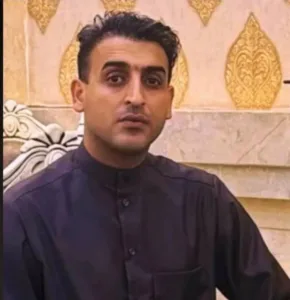
According to reports received by the Karun Human Rights Organization, prisoners held in Sheiban Prison in Ahwaz have nicknamed “Ehsan Adibi Mehr” as the “second Khalkhali (Khalkhali refers to Sadegh Khalkhali, who was appointed as the Sharia judge of the Revolutionary Courts after the 1979 Iranian Revolution. He became notorious for ordering the execution of a large number of officials from the Pahlavi regime, as well as opponents of the newly established Islamic government, and the Judge of Death of Ahwaz.” As the head of Branch 1 of the Revolutionary Court of Ahwaz, he has in recent years issued numerous heavy sentences, including executions and long-term imprisonments, in high-profile cases — sentences which, according to human rights sources, have been accompanied by widespread violations of fair trial principles.
Controversial Cases
Some of the notable cases handled by Ehsan Adibi Mehr include:
The case of Masoud Jamai, Alireza Mardasi, and Farshad Etemadifar:
These three were charged with crimes including “corruption on earth,” membership in anti-government groups, propaganda against the regime, and conspiracy. Each was sentenced to two death penalties and one year in prison. In the same case, Saman Hormatnejad and Davood Hormatnejad were sentenced to 12 and 15 years in prison, respectively. Reports indicate that the defendants were denied access to independent lawyers and that their confessions were extracted under pressure and torture. The health condition of Jamai and Mardasi has been described as critical.
The case of six Ahwazi civil activists:
Ehsan Adibi Mehr also sentenced six individuals — Ali Mojaddam, Moein Khenfari, Mohammadreza Moghadam, Seyed Salem Mousavi, Seyed Adnan Mousavi, and Habib Deris— to death for allegedly participating in the killing of two Basij members, a police officer, and a soldier. In the same case, Fares Ramahi (Amouri) was sentenced to 35 years in prison, and Jasem Alboghobish to 15 years. These individuals were arrested by the Intelligence Ministry in Ahwaz and surrounding cities between 2017 and 2018.
New Wave of Sentences After the Iran–Israel War
Following the Iran–Israel war, around 80 Ahwazi citizens were transferred to Ward 5 of Sheiban Prison in Ahwaz after weeks of interrogation under inhumane conditions. Only two days after their transfer, Branch 1 of the Revolutionary Court of Ahwaz, presided over by Ehsan Adibi Mehr, issued heavy sentences for them:
• 5 years in prison for espionage and collaboration with Mossad
• 1 year in prison for propaganda against the regime
• 2 years in prison for insulting Ali Khamenei
• 2 years travel ban
• 2 years of mandatory participation in so-called “reform sessions” organized by the Basij and IRGC
These individuals, whose average age ranges from 23 to 28 and who mostly belong to the 1990s and 2000s generations, had previously been kept in Sheiban Prison quarantine under extremely harsh conditions and severe deprivation. Reports state that the sentences were issued in absentia, via video conference, in a mass trial format, and likely with only a court-appointed public defender present.
Torture and Forced Confessions
A significant part of these cases is based on confessions obtained under pressure and torture. Human rights reports stress that the principles of fair trial were violated in many of these cases: defendants were denied access to independent lawyers and were kept in prolonged solitary confinement under inhumane conditions.
Human Rights Reactions
The issuance of such heavy sentences has sparked a wave of international protests and concern. Human rights organizations, citing the dire situation of political and ideological prisoners in Sheiban Prison, have condemned these trials as unfair and illegitimate and have called for international pressure to stop the executions and improve detention conditions in this notorious prison.