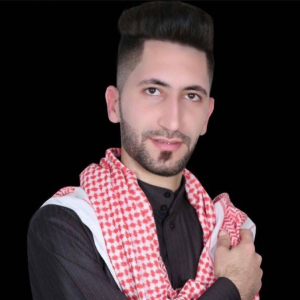
According to documents obtained by the Karoun Human Rights Organization (KHRO), “Mostafa Halichi” widely known by his pen name Mostafa Jamal, an Arab poet, translator, and cultural activist imprisoned in Sheiban Prison in Ahwaz, has written a powerful testimony exposing the systematic repression of Arab civil society activists, physical and psychological torture, and the imposition of severe prison sentences through politically motivated judicial proceedings.
Opening his letter with the words, “They say a poet gives voice to the feelings of their society. But when the poet is imprisoned, who will speak for them?” Jamal describes the plight of imprisoned writers and artists, comparing the lives of civil activists in Ahwaz to “walking through a minefield.” He calls on the international community to hear the voices of those silenced behind prison walls.
Criminalizing Cultural Expression
In his testimony, Jamal explains that throughout his career he sought to serve his community through literature, journalism, and the arts, promoting the literary and cultural heritage of Ahwaz alongside broader Arabic and world literature.
He argues that cultural work in Ahwaz is routinely treated as a national security threat, writing:
“The situation in Ahwaz is different from the rest of Iran. Even if your cultural activities are conducted legally under the supervision of the Ministry of Culture and Islamic Guidance, you still face serious security threats and prosecution. Security agencies regard even non-political cultural initiatives as challenges to their authority, with consequences ranging from relentless harassment to imprisonment.”
He further questions the authorities’ treatment of cultural figures:
“Is it reasonable that I am considered more dangerous to society than thieves or drug traffickers? In what country is a poet imprisoned for literary ambition? Where else is a writer subjected to brutal torture simply for cultural work?”
From “Minasat Al-Watan” to Two Years of Legal Limbo
Jamal recounts that between 2019 and 2020, he created and managed an online cultural initiative called “Minasat Al-Watan” (The Homeland Platform) to showcase the literary and artistic talents of young Ahwazi Arabs.
Shortly after the project concluded, he was arrested by Iranian security forces. Although his activities were entirely cultural, he says security authorities fabricated politically motivated charges against him. As a result, he spent two years in pretrial detention—from 2020 to 2022—without a final verdict.
He was eventually released on the condition that he cease all literary and media activities. Following his release, he says he was effectively forced into unemployment and isolation for another two years.
Rearrested in December 2024
After returning to work as a translator of Arabic and Persian texts, Jamal says his activities lasted only six months before he was arrested again in December 2024 by Iran’s Security Police.
Describing his interrogation, he writes:
“During questioning I was beaten, humiliated, and subjected to severe abuse in an attempt to force me to confess to fabricated security charges, including membership in separatist groups, cooperation with opposition movements abroad, and establishing a group to undermine national security by sharing information about political prisoners.”
He states that the only basis for these allegations was his contact with Mokhtar Al-Boshouka, a former cellmate from his first imprisonment who occasionally called simply to check on his well-being after his release.
A 13-Year Prison Sentence
Jamal says that the Revolutionary Court, acting under the direction of security agencies, ultimately sentenced him to 13 years and one day of imprisonment, along with a two-year travel ban and prohibition on leaving the country.
In the closing section of his letter, he argues that his case reflects the broader reality faced by many in Ahwaz, where independent cultural, media, political, and even economic initiatives are routinely met with repression.
“I am neither the first Ahwazi poet nor will I be the last whose fate is to be pushed aside, stripped of dignity, or lose the best years of life behind prison walls.”
The Karoun Human Rights Organization strongly condemned the sentence, describing the imprisonment and repeated prosecution of writers, poets, and artists in Ahwaz as a serious violation of freedom of expression and fundamental human rights. The organization called on international human rights bodies and global institutions to take urgent action to address the continued persecution of cultural figures in the region.