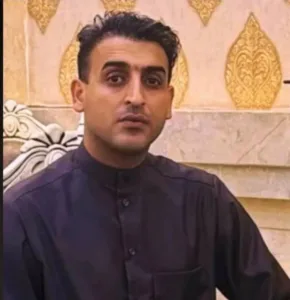
Reports received by the Karun Human Rights Organization indicate that the body of Amir (Abd al-Nour) Nisi, an Ahwazi Arab prisoner of conscience who died in Sheiban Prison, was buried on Thursday, 29 Aban 1404 (20 November 2025) under full control of security forces. His family was completely denied the right to hold a funeral or even a proper moment of farewell.
According to information obtained from local sources, only Nisi’s mother was allowed to view her son’s body—and only for a few seconds. Immediately afterward, security forces buried him without the presence of other family members, in a tightly controlled operation that prevented any public gathering or mourning ceremony.
This action constitutes a clear violation of the family’s fundamental rights and demonstrates the continuation of security-driven policies targeting prisoners of conscience, even after death.
Medical Neglect Prior to Death
Amir Nisi, born in 1998, and originally from the village of Beit Danyar, had long suffered from a chronic condition and severe internal infection caused by an untreated ingrown hair. Officials at Sheiban Prison systematically refused to transfer him to medical facilities, and he was not granted even a single day of medical or ordinary leave.
Human rights activists and former detainees identify Khosro Tarfi, the head of Sheiban Prison, as one of the primary officials responsible for creating an environment of medical neglect and intentionally depriving prisoners of essential healthcare.
The Karun Human Rights Organization emphasizes that forced burial and denying families the right to funeral practices represent grave violations of basic human rights. These actions form part of a systematic policy of medical deprivation and pressure against prisoners of conscience. Responsibility for these violations lies not only with the security forces involved but also with the prison administration and the authorities who design and authorize these repressive measures.