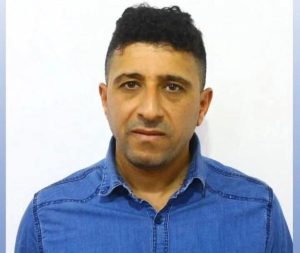
Reports received by the Karun Human Rights Organisation indicate that Nazem Bureihi, an Ahwazi Arab political prisoner, ended his hunger strike on Friday, October 31, after eight days, and was returned to Ward 5 of Sheiban Prison in Ahwaz.
According to these reports, Bureihi decided to stop his hunger strike after receiving promises from judicial officials that he would be included in the pardon plan, benefit from sentence reduction, and be granted medical leave.
Bureihi, who began a dry hunger strike on Friday, October 24, was forced to switch to a wet hunger strike after five days in solitary confinement.
It is worth noting that judicial and security officials have repeatedly made false promises to political and religious prisoners held in Sheiban Prison—regarding pardons, sentence reductions, and medical leave—without fulfilling them in practice.
Earlier, informed sources told Karun that prison authorities had pressured Bureihi’s cellmates to persuade him to end his strike, but he insisted on continuing. According to these sources, the solitary cells of Sheiban Prison usually house inmates convicted of violent crimes and are extremely dangerous, inhumane, and unsanitary.
The Karun Organisation, in a previous official statement, held Khosrow Tarafi, the warden of Sheiban Prison, and Mr. Hawasi, the head of Intelligence Protection at the Khuzestan Prisons Department, directly responsible for Bureihi’s life. The organization stressed that prison officials in the Ahwaz (Khuzestan) region systematically transfer political and religious prisoners to dangerous solitary cells after they begin hunger strikes, subjecting them to severe psychological and physical pressure.
Nazem Bureihi, a civil activist from Hamidiyeh, born in 1986, was arrested on September 10, 2005, along with six other civil activists. After seven months of interrogation and torture, he was sentenced to death by the Revolutionary Court on charges of “acting against national security,” “corruption on earth,” and “enmity against God.” The Supreme Court later overturned the verdict and commuted it to life imprisonment. Despite serving more than 20 years, he has never been granted leave.
In his message, Bureihi stated that over the years, security agencies have repeatedly promised the release or pardon of him and other Arab political prisoners but have blocked those promises from being implemented. He also described his deteriorating health conditions—including kidney problems, skin fungal infections, joint inflammation, and chronic pain—and emphasized that the authorities’ neglect had forced him to resume his hunger strike.